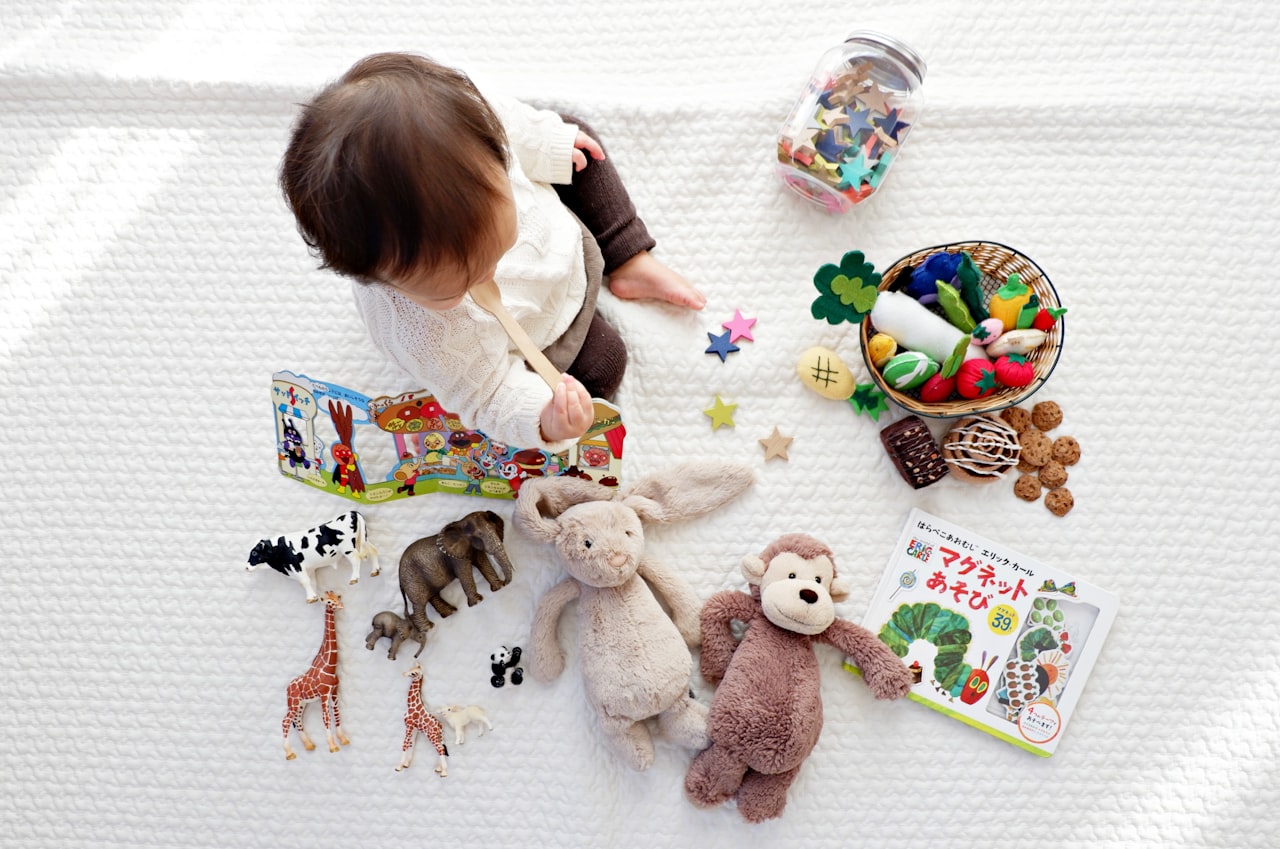
Our living room used to look like a toy shop that had been robbed in reverse. Every basket was full, every surface had something plastic on it, and the children still complained there was nothing to play with. The rotation system I am about to describe took about an hour to set up, cost nothing, and quietly returned about 20 minutes a day to us. It is not a productivity hack. It is just a slower way of owning fewer visible toys at once.
The problem is not the number of toys, it is the number of visible toys
Most families I talk to have somewhere between 60 and 200 individual toys in circulation, counting the little animals and the loose cars. That is not unusual and it is not a moral failing. Birthdays, hand-me-downs, and one enthusiastic grandparent will do that in about two years.
The issue is that when all 200 items are visible at once, a small child sees noise, not choice. Researchers at the University of Toledo found in a small 2018 study that toddlers played longer and more creatively with 4 toys in the room than with 16. You do not need to memorize the study to feel the effect. Watch a 3 year old in a room with three things and a room with thirty. The first room is quieter.
What a rotation actually is
A rotation is a rule that says: only a small portion of the toys live in the living room at any one time. The rest sleep in a closet, a bin under a bed, or a shelf in the garage. Every one to three weeks, a small handful gets swapped in and out.
That is the entire idea. There is no app, no color coding, no laminated chart. If you ever see one of those on a parenting site, you can safely close the tab.
Setting it up in one Saturday afternoon
Pick a 90 minute window when the children are elsewhere or asleep. Bring the following: four opaque bins or bags, a marker, and coffee. Then work through these six steps.
- Gather everything. Pull every toy from every room into one pile in the middle of the living room. Yes, it will look worse before it looks better.
- Bin one: goodbye. Broken things, incomplete sets missing key pieces, duplicates, and anything nobody has touched in six months. Be honest. This bin goes to donation or the bin.
- Bin two: the always-here group. Two or three items that are so central they never rotate out. In our home it is the wooden train set and a bin of stuffed animals my daughter sleeps with. Yours will be different.
- Bin three: this week’s rotation. Aim for 8 to 12 items of genuine variety. One building thing, one pretend-play thing, one art thing, one book stack, one puzzle, one small-world set. That is enough.
- Bin four (and five, and six): storage. Everything else, sorted loosely by category, into closed bins. Label the outside so you are not opening every bin in three weeks to find the magnet tiles.
- Put bins three and two on the shelves. Everything else goes out of sight. If a bin does not fit in a closet, it goes on top of a wardrobe. The point is invisibility.
By the end, the living room should look almost empty compared to what it was. That will feel wrong for about 48 hours.
The rhythm after that
Once a week, or every other week, spend 10 minutes swapping. Take three or four things off the shelves, put them into storage, and pull three or four different things out. That is the entire ongoing cost.
Some families do this on the same evening each week, tied to another quiet routine like laundry folding. Others do it whenever the room starts to feel loud again. Both work. If you like predictability, pick a night. If you like reading the room, do not.
A few practical numbers we have landed on after two years of doing this:
- 8 to 12 toys visible at any one time for a child aged 2 to 6.
- 1 to 3 weeks between rotations. Any faster and children do not settle into deep play. Any slower and things get stale.
- 2 or 3 items that never leave. Children need continuity, not just novelty.
- 15 to 20 minutes saved most evenings on tidy-up, because there is simply less to tidy.
How to introduce it without making it a Thing
Do not announce the system to your children. Do not explain the philosophy. Do not use the word rotation. Just do it while they are out of the house or asleep, and let them find it.
The first day, a 4 year old might ask where the marble run is. You can say, honestly, that it is resting for a bit and will come back later. Most children accept this the way they accept that some cousins visit and some do not. If they specifically ask for a stored item three days in a row, get it out. That is a signal, not a defeat.
If you have older children who notice the shift, you can say a sentence about it. Something like: we have a lot of stuff, and it is nicer when there is less out at once. That is enough. This is one of those home organization systems that works better when it is felt than when it is discussed.
Where this tends to break down
Three failure modes come up over and over when parents email me about this.
The first is the storage location is too inconvenient. If the rotation bins live in the loft or behind three other boxes, you will not swap. Put them somewhere you can reach in under 60 seconds.
The second is the visible collection quietly grows. A new gift comes in, nothing goes into storage, and within a month you are back to 40 visible items. The rule that helps: when something new enters the living room, something else leaves that day.
The third is the rotation becomes an obligation. You start feeling guilty for not swapping this week. Let that go. A system that makes you feel like you are failing at Sunday afternoon is not a system, it is a chore. Skip a week. Skip a month. The bins will wait.
A Tuesday evening, as it actually goes
Here is what a real evening looks like now. It is 5:40 pm. My two children, ages 4 and 7, are on the rug. Visible on the shelves: a basket of wooden blocks, one puzzle, a small tub of animal figurines, three picture books, and a set of scarves for dress-up. That is all.
The 4 year old is building a zoo with the blocks and the animals, which he has combined without being told to. The 7 year old is doing the puzzle and half-listening to a story on the speaker. At 6:15, when I call them for dinner, tidy-up takes about 4 minutes because there are six things to put back, not sixty. Nobody cries about it, which is not because my children are particularly calm but because there is genuinely not much to argue about.
That evening used to take 15 minutes of nagging. This is not a transformation story. It is just a smaller room, and a smaller room is a kinder room.
What to do with the truly stuck cases
Some households have a child who forms attachments to almost every object and will notice if a single Lego brick is missing. If that is you, do not force the full system. Start with one category. Only rotate the art supplies, or only the pretend food. See how it lands over a month. If nobody protests, add another category.
For families with multiple children of different ages, keep one shelf for shared toys and give each child a small private bin that does not get rotated by you. The rotation applies to the common space, not to the personal one. This tends to lower the sibling friction that comes with any household change. If you are working on that separately, our notes on sibling and family communication pair well with this.
The American Academy of Pediatrics has a good short piece on how fewer, open-ended toys support deeper play, which is worth five minutes if you want the developmental case for what your tired self has already noticed.
A last small thing
The rotation is not the point. The point is that a calmer room makes almost everything else in the evening easier, from the dinner handoff to the walk toward bedtime. When there is less visible clutter, adults are less snappy too. It turns out we were also playing the game of too much stuff.
You do not have to do the whole Saturday setup this week. You could just pick five toys, put them in a bag, and hide the bag in a closet for eight days. See if you notice anything. That is a real first step, and it costs nothing. If it helps, our editorial standards page explains how we test the small routines we write about, and you can always write to us if you find a version that works better in your house.