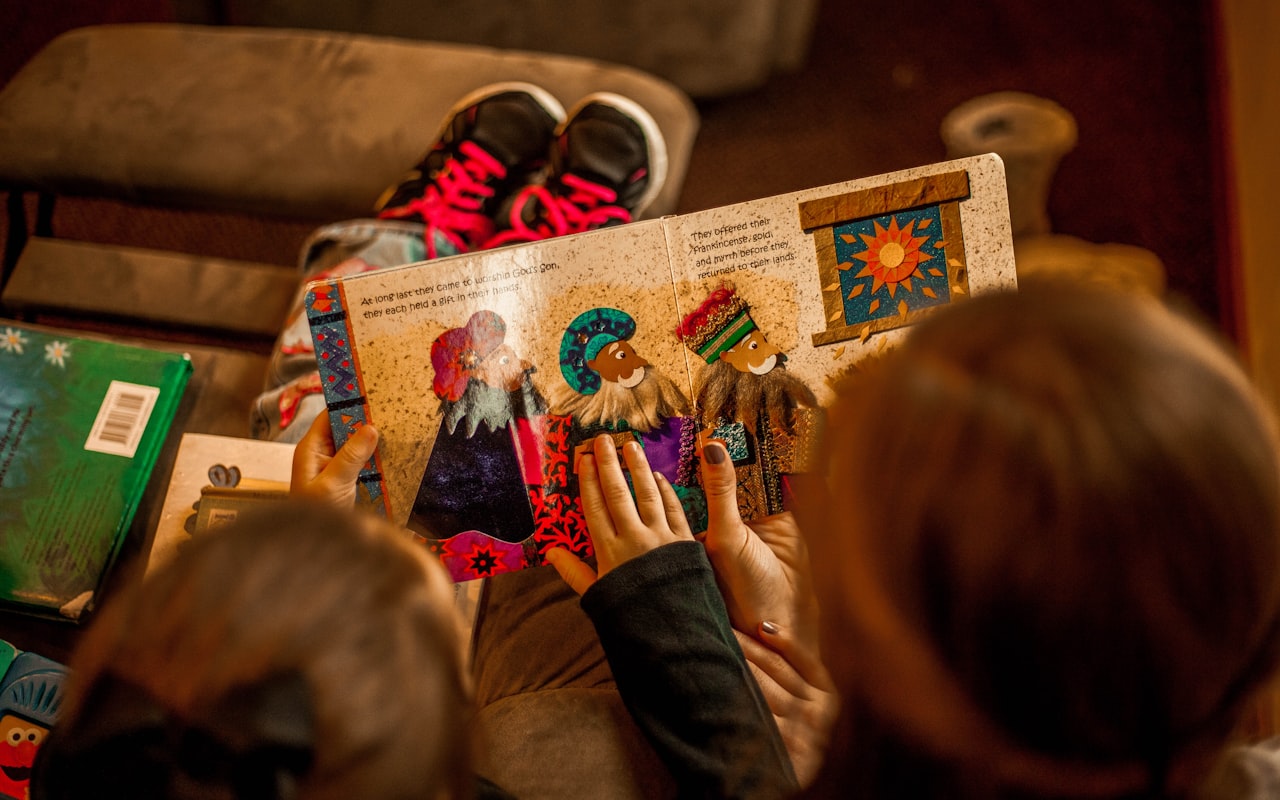
Somewhere between the dishwasher starting and the dog realizing he has not been walked, the read-aloud plan quietly dies. The book is on the shelf. The seven-year-old has become a puddle on the rug. The ten-year-old is finishing a worksheet with the energy of someone signing a hostage note. And you, holding a hardcover you actually looked forward to opening, are wondering if reading together tonight is worth the argument it will take to start.
Reading aloud on a Tuesday is not the same activity as reading aloud on a Saturday. It has to fit inside a tired household, not decorate a rested one. That difference is the whole game.
What a tired Tuesday actually looks like at 7:42 p.m.
By the time dinner is cleared and pajamas are on, most school-age kids have been performing since about 8:15 that morning. That is nearly twelve hours of sitting still, listening, decoding, negotiating with peers, and holding a pencil. Their willingness to receive one more input, even a lovely one, is not infinite. Neither is yours.
When I picture a real school night, I picture a couch that already has a sock on it, a lamp that needs to be moved because someone shoved the end table, and at least one child who insists they are not tired while yawning mid-sentence. This is the room the read-aloud has to fit into. Not the imagined room from a picture book about bedtime, where a mother in a soft cardigan sits beside a smiling child who has already brushed their teeth.
The mismatch between what read-aloud is supposed to look like and what our evenings actually contain is, I think, why so many families quietly abandon it around second grade. It is not that the value disappears. It is that the staging becomes impossible.
The five-minute floor, not the thirty-minute ceiling
The single change that made this work in our house was lowering the number. Not the aspiration, the number. We stopped promising ourselves twenty or thirty minutes of read-aloud and started promising five. Five minutes is short enough that no one, including the reader, can credibly argue it is not worth starting.
What actually happens on a good night is that five minutes becomes twelve, because once you are into the chapter, nobody wants to put the book down. What happens on a bad night is that five minutes is five minutes, and that is fine. You did the thing. You are still a reading family. Nobody cried.
The American Academy of Pediatrics on healthychildren.org has been clear for years that reading aloud continues to matter well past the age children can read on their own. What they do not always mention is that the dose matters less than the streak. Five nights of five minutes builds more of a habit than one glorious Sunday of forty.
Choosing the book so it does not fight you
Half the resistance is book choice. If you are reading a classic you loved at nine, and your actual nine-year-old finds the sentences long and the vocabulary strange, you are asking them to enjoy a workout. That is a Saturday activity. On a school night, the book has to do some of the lifting.
A few things I look for when picking a school-night read-aloud:
- Chapters under about 12 minutes of reading time, so you can end at a natural break.
- A voice that is slightly funnier or weirder than the child would pick alone, because novelty carries tired brains.
- A protagonist within two years of your listener, so the emotional stakes land without translation.
- Physical size that fits in one hand, because you will sometimes be reading while stirring lentils.
If a book is not working after three sittings, retire it without ceremony. Nobody has to finish a read-aloud they are not enjoying. Modeling that a book can be quit is its own literacy lesson.
The staging trick: attach it to something already happening
Read-alouds that require a whole new activity to begin, everyone stops what they are doing, gathers on the good rug, opens a book, tend not to survive Tuesdays. Read-alouds that piggyback on something already happening survive almost anything.
The three staging spots that work in most homes:
- The last ten minutes of dinner. Plates are still on the table, nobody has stood up yet, and a chapter can happen with cheese still on the board.
- The gap between teeth-brushing and lights-out. Kids are horizontal, pajamas are on, and the day cannot really get any smaller.
- Bath time, if you have a young enough listener. They are contained in warm water and cannot leave. Read from the doorway.
Pick one. Do not try to run a read-aloud at all three or you will feel like you are always about to fail one of them. Pairing this with a steady sleep window helps too; our notes in sleep and daily schedules get into how a predictable lights-out time makes the pre-bed slot workable in the first place.
When your kid says no, and means it
Sometimes the child who used to beg for one more chapter is now the child who says, flatly, that read-aloud is boring and can they please just have their audiobook. This is not a rejection of you. It is a nine-year-old realizing they have preferences and testing whether preferences count.
A few responses that tend to keep the door open:
Offer the choice of book instead of the choice of whether. “You pick, I read” often unsticks a stalled evening. Let them draw or fold laundry or build LEGO while you read; comprehension does not require eye contact. Read a chapter of their audiobook out loud, so the transition between formats feels less like winning and losing.
If the resistance is coming from a homework meltdown that has bled into the evening, the read-aloud is not the real problem. Our piece on how to sit with a homework-refusing child without an argument is more useful than any book-selection trick on a night like that. Fix the earlier thing first.
When it goes wrong, and it will
Some nights the read-aloud collapses. The four-year-old head-butts the seven-year-old during page two. The dog eats a corner of the bookmark. You lose your voice at the exact moment the narrator is supposed to sound menacing. One child is crying about a spelling test and the other is asking, with real curiosity, whether people can be allergic to Wednesdays.
On those nights, close the book. Say, out loud, “tonight is not a reading night, we’ll pick it up tomorrow,” and mean it. The single worst thing you can do for a long read-aloud habit is force a bad session. Kids remember the feeling of a routine more than the content of it. If read-aloud feels like being trapped, they will negotiate against it forever.
A useful rule I stole from a friend: if I have said any sentence twice in a rising voice, the book goes back on the shelf. That is the signal, not the clock.
What actually changes after about six weeks
The reason to protect the five-minute floor, even on ugly weeks, is that read-aloud compounds in a way that is hard to see from inside a single Tuesday. Around week four or five, if you have managed roughly three to four nights a week, something shifts. The book becomes a shared reference point. Kids start quoting it at breakfast. A sibling who was refusing to listen starts listening from the next room and then, without discussing it, sits down.
You also start hearing your children use sentence shapes they got from the book. Longer clauses, better verbs, jokes with a setup and a payoff. Reading aloud is, among other things, an ambient vocabulary bath. The U.S. Department of Education’s parent resources point at this too: kids who are read to keep growing their listening vocabulary faster than the one they build alone, which pays off later in reading comprehension.
None of that shows up on a Tuesday. All of it depends on Tuesdays.
The rest of the routine has to leave room for it
Read-aloud does not survive a household that is running six minutes late every night. If dinner is landing at 7:20, backpacks are being unpacked at 7:50, and shower negotiations start at 8:10, there is no five-minute pocket to give the book. The evening itself has to be a little shorter.
Two changes that bought us the pocket:
First, packing tomorrow’s bag before dinner, not after. Our note on the backpack reset that saves Monday mornings is really about this: front-loading the small logistics so the last hour of the day is not full of paperwork. Second, keeping a low-effort dinner in rotation two nights a week; the meal planning and household systems pieces cover the mechanics, but the point is that a scrambled-eggs-and-toast night frees fifteen minutes you did not know you had.
The read-aloud is not a bonus activity you fit in if there is time. It is a small non-negotiable that the rest of the evening has to bend around, the same way brushing teeth is. Once it moves into that category, the arguing about whether to do it mostly stops. What is left is just the reading, which was the point.