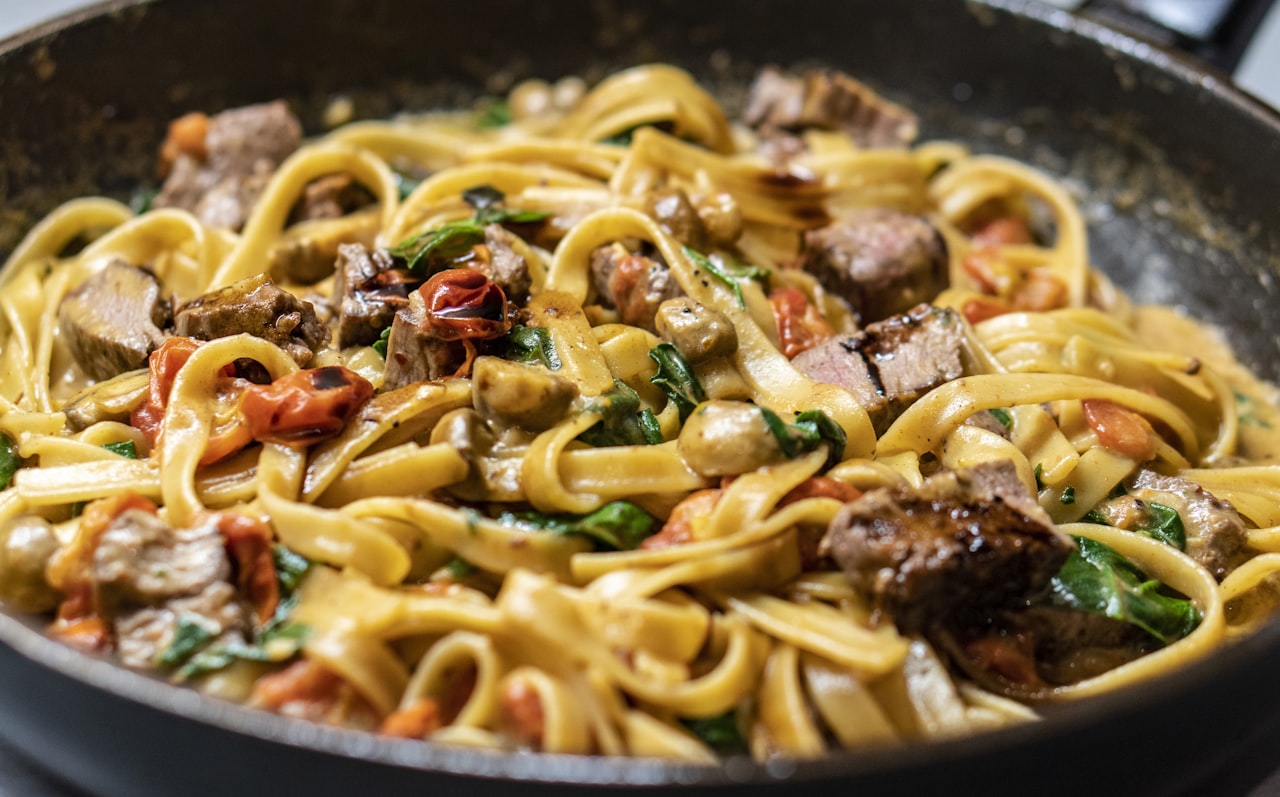
Some evenings in our house have a specific soundtrack: a four year old narrating a plastic dinosaur battle, a nine year old asking about a spelling word, a dog barking at the mail slot, and a kettle nobody remembers turning on. Dinner still needs to happen. This is a piece about the pans we reach for on those nights, and why we stopped trying to plate anything that requires two burners.
The premise is small. One pot, one lid, one board, one wooden spoon. If a recipe needs a colander or a second pan, it belongs to a quieter night. The point is not to be a hero in the kitchen. The point is to still be pleasant company by 7:15pm.
Why loud evenings deserve their own menu
A calm Tuesday and a chaotic Thursday are not the same cooking environment, even if the ingredients in the fridge look identical. On a loud evening you are also refereeing, listening, reminding someone to feed the cat, and occasionally standing between two siblings who love each other but not right now. Your working memory has other tenants.
When we treat these nights as their own category and cook to fit the noise, the meal lands earlier, the sink stays shallower, and nobody eats standing up. That is the whole win. If you want more scaffolding for the surrounding hour, our notes on meal planning and household systems pair well with what follows.
The rules we quietly follow
Over about two years of testing, five rules kept surviving. They are not clever. They are just what worked when the kitchen was loud.
- Under 35 minutes, start to plate. Anything longer and the volume in the house has time to escalate.
- Fewer than eight ingredients on the counter. Salt, pepper, and olive oil do not count. Everything else does.
- One heat source only. Stovetop or oven or slow cooker. Not two at once.
- The lid must fit. Because a lid means you can walk away for four minutes without a smoke alarm.
- Leftovers must survive a lunchbox. If it turns to glue by morning, it belongs to a different week.
None of these are moral positions. They are just filters that stop us from choosing a recipe we will resent by step three.
Six dinners that earned their spot
These are the ones we come back to. They are ordered roughly by how loud the evening is allowed to be.
| Dinner | Vessel | Active time | Total time |
|---|---|---|---|
| Sausage, white bean, and greens stew | Dutch oven | 10 min | 30 min |
| Sheet pan gnocchi with tomatoes | Sheet pan, 425F | 8 min | 25 min |
| Coconut chicken and rice, one pot | Deep skillet with lid | 12 min | 35 min |
| Pasta e ceci (pasta and chickpeas) | Wide saucepan | 10 min | 25 min |
| Miso salmon rice bowl | Rice cooker plus foil | 6 min | 30 min |
| Skillet quesadillas with black beans | Cast iron | 15 min | 20 min |
Notice the range. Two are essentially assembly. Two are simmer and forget. Two need a bit of active flipping. On a Wednesday when three kids are asking three unrelated questions, we pick from the top two. On a Friday when the mood in the house is softer, we might reach for the quesadillas because they invite a child to stand on a stool and press the lid down.
A real Tuesday, roughly told
Last week I got home at 5:38pm with a seven year old who had lost a library book and a four year old who was hungry an hour ago. The countertop had an unopened envelope, a violin case, and a small plate of half eaten grapes. The pot I chose was pasta e ceci, because I could pull it together while listening to the library book saga.
Onion into the wide pan with olive oil at 5:42pm. A tin of chickpeas, a spoon of tomato paste, a splash of water, and 200 grams of small pasta by 5:50pm. Lid on, timer for 12 minutes. During those 12 minutes I found the library book (under the piano bench, of course), signed a permission slip, and refilled two water glasses. We ate at 6:07pm.
Nothing about that evening was calm. But dinner was not the loudest thing in the room, and that is a version of success I have learned to accept.
When it goes wrong
The most common failure is choosing a recipe that is technically one pot but requires perfect timing. Risotto is the classic trap. It is one pan, yes, but it demands 20 minutes of standing and stirring, and loud evenings do not give you 20 continuous minutes of anything. Save it for a Sunday.
The second failure is under-salting because you were interrupted. We keep a small pinch bowl of flaky salt on the counter now, so a child asking about tomorrow’s field trip does not cost the dish its seasoning. The third failure is forgetting to start rice or grains 10 minutes before the main. A one pot dinner served over a starch that is still crunchy is a two pot problem in disguise.
If your evenings feel loud in a way that goes beyond dinner, our writing on sibling and family communication and on sleep and daily schedules may be useful companions. The American Academy of Pediatrics also has practical, non-preachy notes on shared family meals at HealthyChildren.org that we found genuinely grounding.
Shopping the week so the pan is easy
The reason a one pot dinner feels effortless on Thursday is almost always a small decision made on Sunday. We keep a running list of eight staples that make any of the six dinners above possible without a second trip to the store: one tin of chickpeas, one tin of white beans, one tin of chopped tomatoes, one pack of small pasta, one bag of rice, one pack of chicken thighs, one bunch of hardy greens, and one wedge of parmesan.
That is roughly a 25 dollar backbone in most weeks. Add a fresh protein or two, one onion, one lemon, and you can cover four loud evenings without thinking. If shopping and stocking is the friction point, our chores and home organization notes cover the pantry rotation we use, and the MyPlate guidance from USDA is a decent sanity check when the week starts to lean too beige.
Serving it in a way that keeps the volume down
We stopped plating individually on loud nights. The pot goes to the table on a folded towel, with a ladle and a stack of shallow bowls. Children serve themselves, which sounds chaotic but is actually quieter, because nobody is waiting to be handed something. A small bowl of grated cheese, a small bowl of chopped herbs if we have them, and a jug of water rounds it out.
The tone shifts when the food arrives as a shared object rather than six separate performances. Conversation gets a little easier. The four year old asks fewer questions because he can see what is happening. The nine year old, who has opinions about texture, can add or skip the greens without a negotiation.
Two nights a week is enough
You do not need one pot dinners to be your whole meal plan. In our house they cover two, sometimes three evenings a week, usually Tuesday and Thursday, sometimes Sunday when everyone is tired from the weekend. The other nights can be leftovers, a proper cooked meal with two pans, or a very honest bowl of cereal at 6pm followed by toast at 7pm.
If any of this is useful to you, take one dinner from the table above and try it this week. Just one. If it goes well, it will find its way into the next week without you deciding. That is usually how these things stick. Our editorial standards page explains how we test recipes and routines before we write about them, and contact us if a particular pan or pot has saved your evenings; we collect these across households.